The Persian Paradox

Noah Webster defined a paradox as ‘a tenet or proposition contrary to received opinion, or seemingly absurd, yet true in fact.’ [1] The American Heritage Dictionary of the English Language defines a paradox as ‘a statement that seems to contradict itself but may nonetheless be true.’ [2]
An interesting paradox is taking place in our present day, and many do not know. While the drums of war beat, the Spirit of revival flows. In this specific area, these two things cannot intermingle, or so we’re led to believe. However, they do and they are.
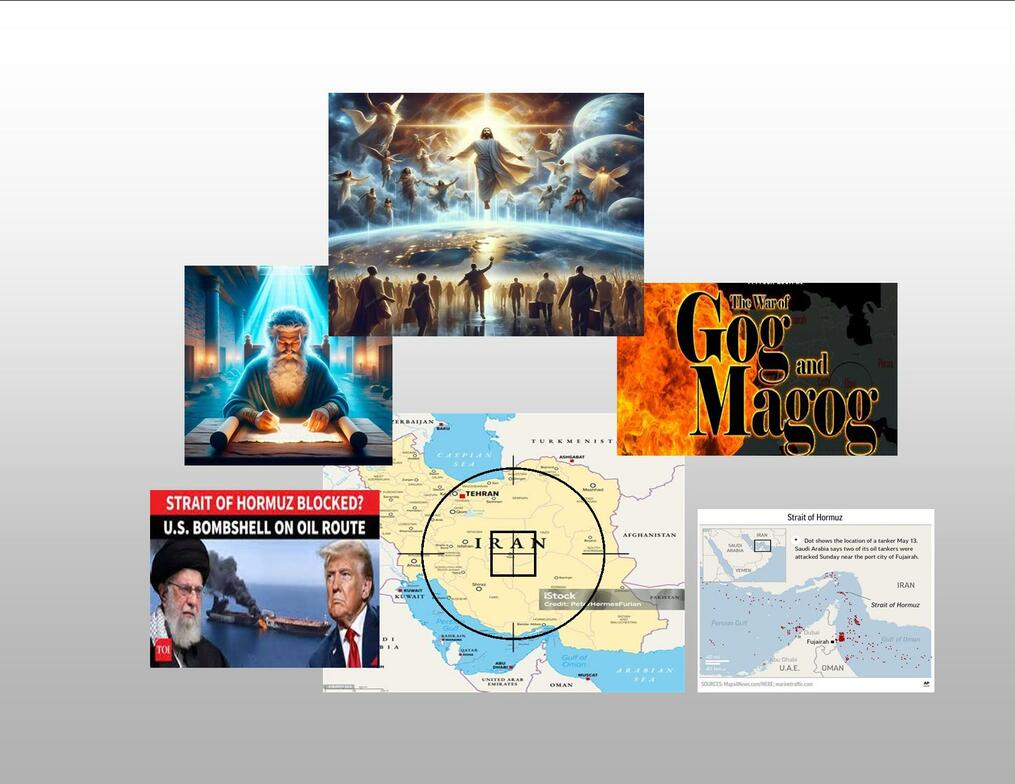
The world’s attention seems to be geared to one focal point – the crisis taking place in Iran and the area of the Strait of Hormuz, where roughly 25-30 percent of the world’s traded crude oil passes daily. This conflict is currently affecting every human being alive today. Because of the brutality of the regime of the ayatollahs, Iran has been a linchpin of world events for several years.
While Iran certainly has its place in world history, it also holds an important place in Bible prophecy. In Scripture, the modern region of Iran is also known as Elam, Parthia, Media, and, its most well-known name, Persia. Iran (not by its current name) is mentioned in the list of nations in the time after Noah’s Flood. In Genesis 10:2, we see the name Madai, which was the forerunner to the Medes, or Media, which later made-up half of the unbalanced Media-Persian Empire. In Genesis 10:22, we see Shem had a son named Elam. The region in which Elam settled is located, today, in southwestern Iran. By the time the years included in Genesis 14 came to be, Elam had become a regional power.
As we journey through the Bible, we see modern Iran holds a major place in God’s program across the ages, especially as it pertains to His people, Israel.
As an important side note, Daniel the prophet recorded (in approximately 534 BC) that he was being tormented for twenty one days by a powerful dominion spirit which he referred to as ‘the prince of the kingdom of Persia’ (Daniel 10:13), from which he was delivered and comforted by Michael the archangel.
Iran was not always the adversary of Israel as we’ve seen for the past several decades. God had a plan and, at times, used the Persian people to complete that plan.
The entire book of Esther takes place in Persia. As we read that account, we see that the land of Persia was a location of God’s preserving the Jewish people as he used the young queen to overthrow the biggest threat to His and her people at that time, the wicked man named Haman.
During the time of the prophet Isaiah, we see God using Persia to restore Israel through a king named Cyrus. King Cyrus was named and prophesied in Scripture more than 150 years before he was born. The prophecy of Israel’s deliverance through this Gentile king sees its fulfillment in the Books of Ezra and Nehemiah. Again, uses Persia to deliver Israel.
As we pan through the ages and throughout Scripture, we see Persia playing a prominent place during the time of the prophet Daniel. Things begin to shift in regard to Persia’s dealings with Israel. As we venture forward, we see friend becomes foe. Throughout the book bearing his name, Daniel mentions Persia several times in several different ways. In Daniel 2, originally occurring in approximately 602 BC, we read the account of King Nebuchadnezzar’s dream of the metallic image. The ancient empire of Media-Persia is seen in this vision as the chest and arms of silver. Later, in Daniel 7, occurring in approximately 553 BC, we read about Daniel’s vision of the four wild beasts. In verse 5, we read Daniel’s account of the second beast, one resembling a bear with an interesting trait – it was raised up on one side showing more power and strength to that side as opposed to the other. This is an accurate representation of the historic Media-Persian Empire in which Persia was the stronger, more dominant half of the empire. In this vision, Daniel sees the Media-Persians overthrown by a third wild beast, one like a leopard, demonstrating the speed and quickness by which it conquered other lands (Dan. 7:6). History tells us that the empire of the Medes and Persians was conquered by the Grecian Empire, led by Alexander the Great (356-323 BC).
In Daniel 8, which occurred in roughly 551 BC, we see Daniel’s vision which ultimately was fulfilled in the life of the man, Alexander. We see the time of Alexander’s conquest of Media-Persia, but we also see how quickly his reign ceased. Alexander was only 32 years old when he died of malaria. History shows that it took roughly six years for Alexander to fully conquer the Medes and Persians (approximately 334-328 BC). Just a few short years later, the young king was dead.
As I was praying and meditating upon the structure of this writing, the Holy Spirit showed me something I had read multiple times in my studies of the Book of Daniel and had even highlighted but had overlooked.
In order to piece this puzzle together, we must first look at a couple other passages in the Bible.
Ecclesiastes 1:9-10 says, “The thing that has been–it is what will be again, and that which has been done is that which will be done again; and there is nothing new under the sun. Is there a thing of which it may be said, See, this is new? It has already been, in the vast ages of time [recorded or unrecorded] which were before us.” Then, in Ecclesiastes 3:15, we read, “That which is now already has been, and that which is to be already has been; and God seeks that which has passed by [so that history repeats itself].” [3]
In both passages, the writer of Ecclesiastes assures us that, in God’s economy of time, He permits history to repeat itself, thus the truth there is nothing new under the sun.
Understanding the context of these passages, a remarkable truth comes into focus in Daniel 8. After the prophecy of Alexander’s conquest and demise, we come to the interpretation of the vision in verses 15 through 19. In verse 17, we read, “So he came near to where I was standing, and when he came I was frightened and fell on my face; but he said to me, “Son of man, understand that the vision pertains to the time of the end.”” [4] To truly understand the meaning of this prophetic word, we have to apply the Biblical law of Double Fulfillment. We have a historical fulfillment seen in the life of Alexander the Great. However, Daniel undoubtedly shows in the interpretation of the vision there will also be a future prophetic fulfillment of that single verse when he heard a voice saying to him, “Son of man, understand that the vision pertains to the time of the end (emphasis added).”
Fast-forward to our generation. The result of the Iranian Revolution in 1979 saw the ayatollahs ushering in a period of violence and oppression against their own people as well as a massive increase of hatred against the West, particularly who the radical Islam of the ayatollah regime refer to as “the Great Satan” and “the Little Satan,” the United States and Israel, respectively.
The demonic principality spirit spoken of by Daniel is rearing its ugly head once again. In Ezekiel’s prophecy of the battle of Gog and Magog in chapters 38 and 39, we see the Persian hatred against Israel reach its apex. Along with nations such as Russia and Turkey, Iran will launch an invasion against Israel but will be supernaturally defeated by the hand and power of God in the time of the end. The prophecy of Ezekiel 37, known as the Valley of Dry Bones, was fulfilled at the rebirth of Israel in 1948. Next in line along the prophetic cycle of Ezekiel – the fulfillment of the destruction of Israel’s adversary’s of which Persia, or Iran, is a part.
Up to this point, we’ve demonstrated that Iran and the Persian people have a well-documented history of being God’s vessel for protecting and restoring Israel as well as a history of being supernaturally led by a demonic principality spirit which wants to oppress and destroy the Jewish people.
However, is something brewing in the prophetic realm that shows God, once again, has a plan for a remnant in Persia?
First, let’s look at Biblical history to further establish the link. In Acts 2, we see that Parthians, Medes, and Elamites, all speakers of and fluent in the Persian language, were all present in Jerusalem on the Day of Pentecost. These people would have traveled from the region of Persia to become witness to one of the single greatest events in Biblical and world history – the birth of Christ’s Ekklesia, the body we know today as the church.
It is historically documented that the people of Persia considered the Roman Empire of the first century an enemy. The historical record further tells us that, after Pentecost, the apostle Thomas eventually carried the Gospel message and introduced Christianity to the Persians as he was traveling on to India to further spread the message of Jesus Christ. The Persians welcomed the early Christians because they were the enemies of Persia’s enemy, fulfilling the saying, “The enemy of my enemy is my friend!” Christian bishop Nestorian of Constantinople was expelled by the Roman church (which would eventually become the Roman Catholic Church) in AD 431 for political reasons, thus further convincing the Persian rulers that true Christianity was in no way connected to Rome. It is known fact that, after they converted to Christianity, the Persian Christians assisted in the spreading and influencing the modern nations of Yemen, India, Sri Lanka, China, countries of central Asia, Tibet, the Korean Peninsula, Vietnam, and Japan with the Gospel of Christ! What we know as Iran is known for having sent missionaries out almost as the early church of the first century sent missionaries into the land!
As we arrive in our modern times and press into the prophetic future, we discover extremely interesting information.
Before I answer, allow me to, once again, ask a question posed just a few paragraphs earlier – Does God have a prophetic, end times plan for a righteous remnant in Persia?
Is there something occurring, today, that leads us into the correct answer?
Yes, REVIVAL!!!
It is known that the ayatollahs are abjectly opposed to Christianity in order to maintain their grip and belief in apocalyptic, radical Islam. However, something which can be described as nothing less that miraculous occurred during the reign of Ayatollah Khomeini. Due to his oppression and extreme adherence to Shi’ite Islam, he inadvertently became, according to one unnamed Iranian pastor, “one of the best Christian evangelists” in Iran! In 2023, according to one Iranian Muslim cleric, around 50,000 of Iran’s approximately 75,000 Islamic mosques had closed their doors permanently. Depending on the source, it is estimated that there are between one and seven MILLION Christians living in Iran today.
Can this be supported by Scripture? Did God give a glimpse into the prophetic future of the Gospel of Jesus Christ among the Iranian people of today and beyond?
Remember, God said that a principality spirit, embodied in a man, would be destroyed in the time of the end (Daniel 8:17).
Now, what did God say about the future of the Gospel in Persia? Did He even speak a word in this area?
In Jeremiah 49:34-39, we read the following:
That which came as the word of the Lord to Jeremiah the prophet concerning Elam, at the beginning of the reign of Zedekiah king of Judah, saying: “Thus says the Lord of hosts, ‘Behold, I am going to break the bow of Elam, The finest of their might. I will bring upon Elam the four winds from the four ends of heaven, and will scatter them to all these winds; And there will be no nation To which the outcasts of Elam will not go. So I will shatter Elam before their enemies and before those who seek their lives; And I will bring calamity upon them, Even My fierce anger,’ declares the Lord, ‘And I will send out the sword after them Until I have consumed them. Then I will set My throne in Elam and destroy out of it king and princes,’ Declares the Lord. ‘But it will come about in the last days that I will restore the fortunes of Elam,’ Declares the Lord.” [5]
God, through the prophet Jeremiah, said that in the last days He will “break the bow of Elam, the finest of their might” and “I will set My throne in Elam and destroy out of it king and princes” indicating that He will righteously deal with the human leaders and oppressive regime in existence today which so happens to be overcome by the demonic principality spirit of Persia. But the story doesn’t end there. At the end of the prophecy, in verse 39, God speaks a word of hope – “But it will come about in the last days that I will restore the fortunes of Elam. Declares the Lord.”
As a student and teacher of Bible prophecy for almost a quarter century, I can tell you this excites me! We see the hand of God righteously judging the wicked in Persia while, at the same time, bringing hope and blessing to a righteous remnant of several million presently in the land.
To my dear readers, don’t speak idle and destructive words over an entire generation of people in Persia. Instead, pray and watch. Remember our Persian brothers and sisters. Stay up to date on current events, secular and spiritual, in Iran. It truly has become one of God’s prophetic epicenters.
Until next time…
Burn the Ships,
Pastor Jamie
[1] Entry from Webster’s Dictionary of American English (1828).
[2] Entry from the website of The American Heritage Dictionary of the English Language: ahdictionary.com.
[3] Both Scripture references (Eccl. 1:9-10 & 3:15) taken from the Amplified Bible, Classic Edition; 1954, 1958, 1962, 1964, 1965, 1987 by The Lockman Foundation.
[4] Daniel 8:17 taken from the New American Standard Bible, 1995 Edition; Copyright © 1960, 1962, 1963, 1968, 1971, 1972, 1973, 1975, 1977, 1995 by THE LOCKMAN FOUNDATION.
[5] Jeremiah 49:34-39 taken from the New American Standard Bible, 1995 Edition; Copyright © 1960, 1962, 1963, 1968, 1971, 1972, 1973, 1975, 1977, 1995 by THE LOCKMAN FOUNDATION.